
Visually representing change models is challenging. Indeed, our societies have tried to illustrate this required balance of perspective and action for thousands of years. This assignment incorporates qualitative views of stakeholders from the sports coaching community and reflects on their experiences facilitating change at non-profit organizations. Effective leadership and change management require a well-developed understanding of historical factors, future possibilities, and the modes that propel individuals within organizations to champion necessary innovation and development.
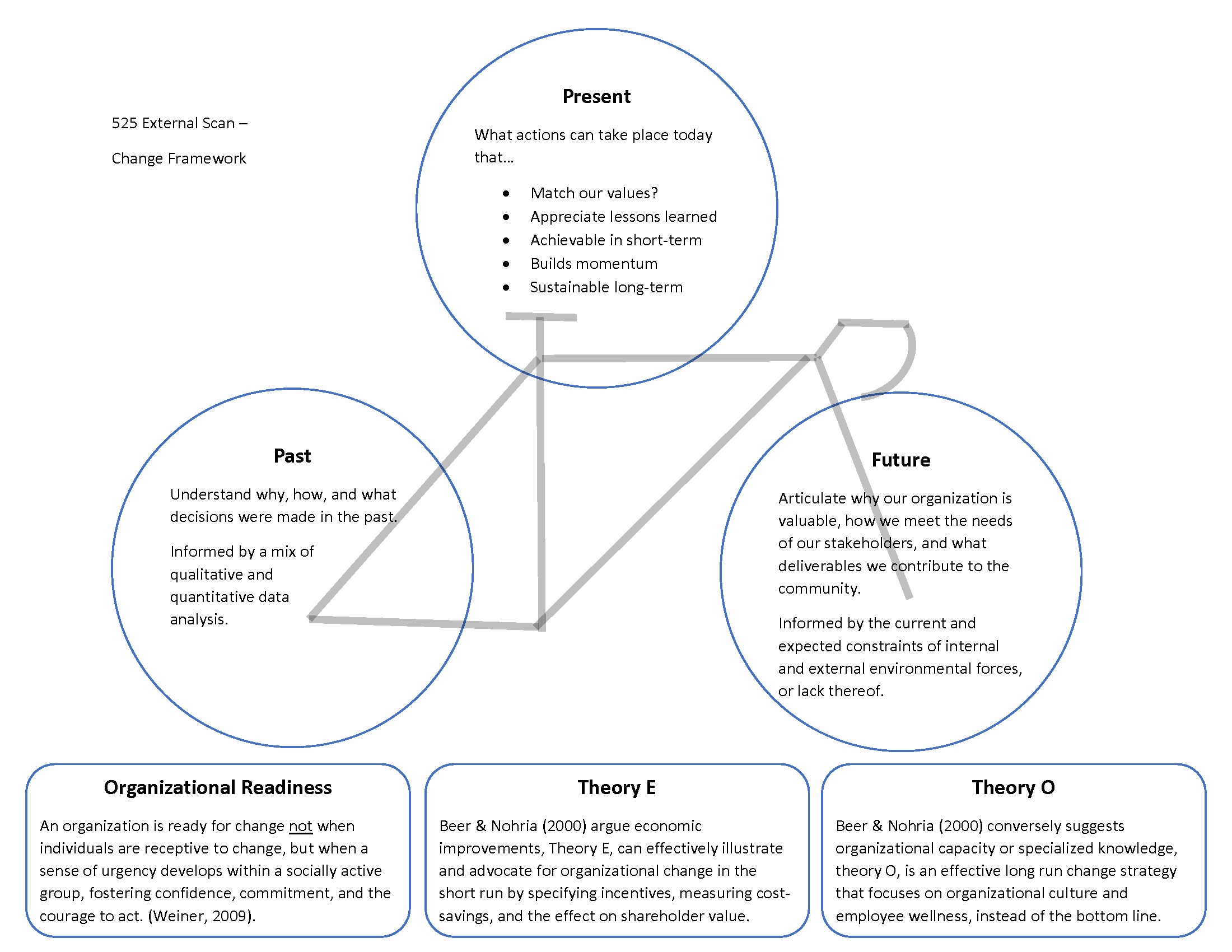 Understanding an organization’s history, culture, and social aspects is required to inform thought leaders. Burnes & Jackson (2011) remind us that change often fails not because of poor planning but a mismatch of values between the proposed change and an organization in its current state. As discussed during my interview, even if an organization is gutted and reborn, social stigmas in the community will extend into the future (anonymous, 2022). Therefore, change-makers must explore the historical context and culture before proposing and implementing significant changes. Connor (1998) reminds us that every change has a reaction, and even Luke Skywalker knows that things don’t usually go the way we expect (Johnson et al., 2017). Therefore, Beer & Nohria (2000) suggest organizations focus on employee wellness and capacity, building specialized knowledge and referred to as Theory O. Moreover, Wiener (2009) encourages change leaders to create spaces and routines that promote social exchange. By helping staff connect and share ideas, the wants of leaders can become the needs of followers, also known as motivation theory, change initiates from the grassroots level. So when we find ourselves lost, let’s first retrace our steps and consult the group.
When faced with uncertainty, acknowledging organizational values and how the roles and responsibilities of the group enact those values illustrates capacity to adapt. When an organization’s values are poorly defined or agreed upon by the stakeholders, building momentum for change is challenging (anonymous, 2022). Harris (2008) suggests that distributing leadership responsibilities within an organization through the appointment and development of informal champions can help maximize an organization’s future leadership potential (as cited by Huggins, 2017). Indeed, when regional leaders feel connected to the overarching organization, this can extend to the community level and help everyone feel connected and confident in strategic innovations (anonymous, 2022). When articulating a realistic vision for the future, reflective practices can help match goals with organizational capacity, renewing staff interest and improving performance (Castelli, 2016). Since we all have limited capacity or bandwidth to think and do, we feel more integrated with the change process when our organizations recognize and facilitate actions with an appreciation for bandwidth; we feel part of something special (anonymous, 2022). Although Bates (2000) suggests that motivation theory is maximized through stakeholder consultation, Secretan (2004) reminds us that an appropriate level of filtering is necessary between the leadership and others to avoid losing the magic of a future vision. When planning the future, aim big but don’t leave the little things behind.
When implementing change, aligning actions with values develops trust, and short-term financial wins can illustrate progress. Building trust and uniting team members through a sense of urgency is a common theme across effective change strategies (Kotter, 1996). Berger (2013) reminds us how social currency, or information that heightens a person’s social status, can create a leader-follower dynamic and use social cognition theory to initiate change quickly (Weiner, 2009). Shifting gears, Beer & Nohria (2000) recommend that incentives, measuring cost-savings, the effects on shareholder value can illustrate short-term results and advocate for continued change. Focusing on economic impacts is also referred to as Theory E. However, Sinek (2020) encourages us to use language and actions that acknowledge our understanding of finite and infinite markets. More specifically, does our organization have a finite lifespan, and are we in a race to a finish line, or are we aiming to outlast the competition and focus more on efficiency and adaptability.
When we can acknowledge and explore the context of the past and unite stakeholders in a common and inspiring vision for the future, we can carefully implement and demonstrate the effectiveness of change in the short run and align with long-run goals.
References
Al-Haddad, S., & Kotnour, T. (2015). Integrating the organizational change literature: a model for successful change. Journal of Organizational Change Management, 28(2), 234-262.
Anonymous. February 15, 2022. Personal Communication.
Bates, A.W. (2000). Managing technological change: Strategies for college and university leaders. San Francisco: Jossey-Bass.
Beer, M., & Nohria, N. (2000). Breaking the Code of Change. Harvard Business School Press.
Berger, J. (2013). Contagious: why things catch on. 1st Simon & Schuster hardcover edition. New York: Simon & Schuster.
Castelli, P. (2016). Reflective leadership review: a framework for improving organizational performance. Journal of Management Development, 35(2), 217-236.
Huggins, K. (2017). Developing Leadership Capacity in Others: An Examination of High School Principals’ Personal Capacities for Fostering Leadership. International Journal of Education Policy and Leadership, 12(1).
Johnson, R., Hamill, M., Fisher, C., & Driver, A. (2017). Star Wars: The Last Jedi.
Kotter, J.P. (1996). Leading change. Harvard Business School Press.
Secretan, L. (2004). Inspire: What great leaders do. New Jersey: John Wiley & Sons Inc.
Sinek, S. (2020). The infinite game. Portfolio Penguin.
Weiner, B. J. (2009). A theory of organizational readiness for change. Implementation Science, 4(67).