
Every rider knows the moment. Rep three of six, your legs are full, your breathing is ragged, and the next three reps suddenly look impossible. Most of the time that isn’t a fitness problem. It’s a pacing problem that started back in rep one.
To help my athletes see what’s going on under the hood, I built a small tool: the Lactate Interval Planner. It estimates how blood lactate climbs during each effort, falls during each recovery, and stacks up across a session. Here’s what it shows, and how you can use the same ideas on your next ride, with or without the tool.
What lactate is actually telling you
Lactate isn’t the villain it was once made out to be. Your muscles produce it all the time, and your body clears it and uses it as fuel. The trouble starts when you produce it faster than you can clear it. Then it accumulates, along with the other by-products of hard work, and that’s the heavy, burning, “I need to stop” feeling.
In an interval session, two things decide how that plays out:
- How hard each rep is, compared with your critical power: the highest power you can sustain for a long time.
- How much you clear in each recovery, which sets what you carry into the next rep.
Get the first one slightly wrong and the second one can’t keep up. Each rep starts a little higher than the last, until you hit your ceiling.
The band you can come back to
For lactate tolerance work, I aim for a band of roughly 4 to 7 mmol/L. In my experience coaching amateur and Masters riders, that’s a level people can return to rep after rep. Above it, they tend to crack, cut the session short, or ride the last reps so badly that they lose the point of the workout.
Every minute you spend in that band builds your ability to handle hard efforts: surging over a climb, closing a gap, or holding a wheel when the group lifts the pace. The goal isn’t the highest number on any one rep. It’s the most good-quality time in the band across the whole session.
What the planner shows
You give the planner two best efforts, such as a 3-minute and a 12-minute effort. From those it works out your critical power and how much hard work you can do above it. Then you build a session: reps, work and recovery times, and the power for each. The chart draws your estimated lactate, second by second.
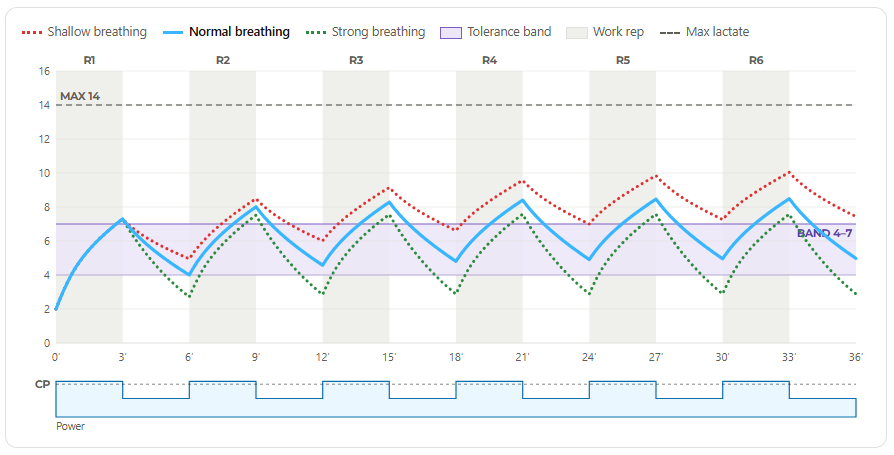
Look at the blue line. The first rep lands right at the top of the band. Each recovery brings lactate back down, but not quite all the way, so every rep starts a little higher. By the middle of the session this rider is spending part of each rep above 7. Nothing dramatic happens on any single rep. It’s the slow creep that ends sessions early.
The planner can also work backwards: pick a format, and it finds the highest power that keeps you in the band for the whole session.
Four things the model keeps showing
1. Tolerance work sits just above critical power. Not far above it. For most formats, the power that stays in the band is only a few percent over critical power, and for longer reps it’s right at it. If you’re riding these as all-out efforts, you’re doing a different workout.
2. VO₂max intervals are a different session. Efforts at your best 5-minute power leave the band during the first rep. That’s fine when the goal is VO₂max, but it isn’t tolerance work, and it’s worth knowing which one you’re doing before you start.
3. Shorter reps and more rest buy you power. Short reps with equal rest (like 1 minute on, 1 minute off) let you ride the highest power while staying in the band. Going from 2 to 3 minutes of rest also helps more than most riders expect.
4. How you recover matters. Easy spinning clears lactate better than coasting or stopping, because working muscles help burn it off. If you stop pedalling between reps, you’ll likely start the next one higher than you think.
What about breathing?
The tool lets you compare shallow, normal and strong breathing during recovery. The idea is plausible: your breathing muscles take up and use lactate, and at least one study found that working the breathing muscles during recovery lowered blood lactate. The practical evidence is mixed, though. A 2024 trial with elite speed skaters found no significant difference, and no study I know of has measured it between intervals.
So the breathing curves on the chart show the idea, not a proven effect. I’m checking the model against my own finger-prick lactate readings, and I’ll share what I find. In the meantime, deliberate breathing in your recoveries costs nothing and helps many riders settle before the next rep.
How to use this on your next ride
You don’t need the tool or a lactate meter to train this way:
- Start just above your threshold power, not at your best 5-minute power. If you know your FTP or critical power, start a few percent above it.
- Pick a format with enough rest. 6 × 3 minutes with 3 minutes of easy spinning is a good first session.
- Spin easily during recoveries. Don’t stop or coast, and take slow, deliberate breaths.
- Judge the session by the last rep, not the first. If rep four feels much harder than rep two, the power was a little too high. Next time, drop it slightly or add 30 seconds of rest.
If a session looks out of reach today, you’ve just found your starting point. Tolerance builds quickly when the reps are pitched right.
An estimate, not a lab test
The planner is an educational model. It gives you a sensible starting point and a picture of what’s happening, but it can’t replace a lactate test, and every rider responds differently. Clearing lactate quickly also isn’t the same as being ready for the next rep: your ability to do hard work above critical power often recovers best with easy recovery. Use the numbers to start a conversation with your coach, not to settle one.
The Lactate Interval Planner is part of the clients-only area for the athletes I coach, and I use it with them alongside their INSCYD testing to plan sessions that fit.
Curious how this kind of planning would fit your season? Book a free 15-minute call, and we’ll talk about your goals.