Most riders never think about who trained their coach. For 11 years at Cycling BC, that was my job.
From 2014 to 2025 I helped build the youth program that became Canada’s national grassroots program, HopOn, and then led coach education across British Columbia. Along the way I became an NCCP Master Coach Developer: one of the people who train the people who train coaches.
Here’s what that work looked like, what it taught me about how adults learn, and why it shapes how I coach Masters riders today.
- NCCP Master Coach Developer
- Learning Facilitator
- Coach Evaluator
- Chartered Professional Coach
- M.A. Learning and Technology
Day one
It started by throwing out the textbook
When my racing career ended in 2014, I’d spent years on the B.I.K.E.S Project, helping kids dream big and stay inspired through the bumps along the road. Cycling BC offered me the chance to build its school program, iRide, and I took it.
Part of getting the job was writing the program’s textbook. Then, in March 2015, Coach Wes and I spent our first month at Coquitlam Middle School: ten school days in a row, then five more after spring break, with four or five classes a day. In the first week I ran it like the textbook, with stations. The students didn’t want stations. This was their gym class. They’d been sitting in class for hours, and they needed to move.
So we threw the textbook out. We got them pedalling, played lots of games, and gave them what felt like recess, with a bike. Over the next two seasons we kept the games that kids loved and that taught the skills, and wrote them down: a book of about 20 games.
Step 1 · Open space
Can I do the movement?
Introduce the movement with lots of room and freedom. Find the basic range of motion.
Step 2 · Timing oval
Can I do it at the right time?
Ride a small oval: turn your head around the cone, stand up in level pedals on the straightaway.
Step 3 · Game
Can I do it in a game?
Finish with a game: a little randomness and friendly competition, with nothing at stake, so riders focus and figure it out.
Instructor training
From one school to a national program
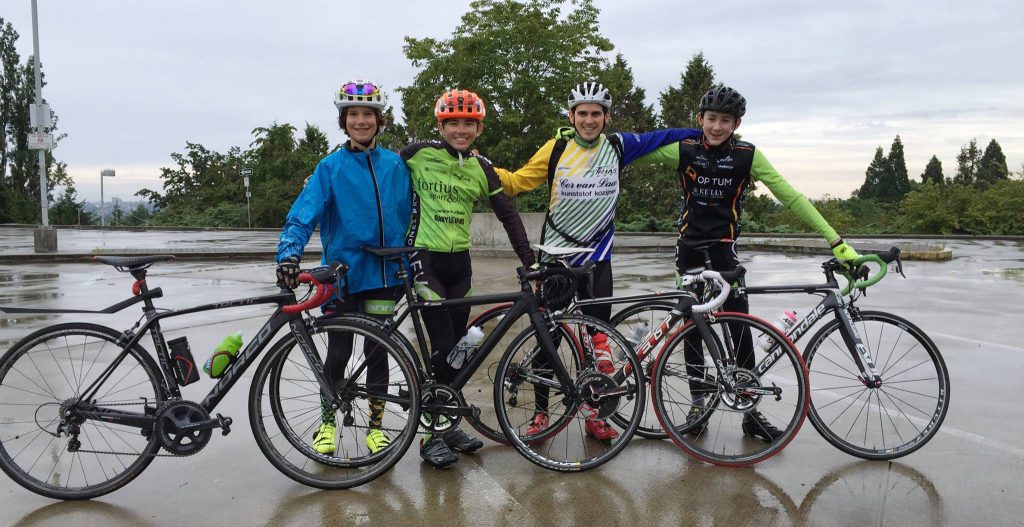
We trained about 20 new instructors a year. After a two-day training weekend, the in-school team started, and so did the after-school instructors, who might only teach an hour or two a week. Every week we held a 30-minute evening call with everyone. The in-school instructors taught the same lesson four, five or six times a day, so they quickly learned which words and which order of activities worked. On those calls they took the lead and passed it on. I mostly facilitated.
In 2017 Coach Doug at Sprockids and I built an after-school model, and by 2019, 33 groups were delivering 47 after-school programs. That year we filmed 100 functional-movement videos plus the games, on a handheld camera because there was no budget for a film crew. COVID gave us an off-season, and by March 2021 we’d finished the package: an interactive e-learning course, a three-page cheat sheet, a 150-page textbook and the full video library. It’s still in the instructor resources on HopOn Canada.
When Cycling Canada took HopOn national, my role was to train the people who train the instructors: the lead Learning Facilitators in each province. That meant trips to Nova Scotia and Montreal in 2021 and Ottawa in 2022. In Nova Scotia, with people from across Atlantic Canada, our icebreaker was the board game Mastermind, played with cones on a field. It showed me in minutes who spotted patterns, who moved the conversation forward and who could pivot a group when it went backwards. My main advice to other provinces: in-school programs sound great but are very expensive and hard to staff, so start with after-school programs and build your clubs.
Back in BC, government funding in 2023 let us train 49 new instructors across seven cities in one spring. Many were teachers or wanted to be. Some of the kids who came to our summer camps have since become instructors themselves, and some are now studying teaching and outdoor leadership. Riders who came up through the pathway and took HopOn instructor training are now racing in Europe. I call those two paths performance and stewardship. Both make me proud. The full story of the program is in From iRide to HopOn.
Coach education in BC
Leading coach education across the province
As Cycling BC’s Head of Coach Development (2020–2024), and then Learning and Technology Director (2025), I led the NCCP courses that a provincial organization delivers and supported evaluations at the higher levels. The easiest way I know to remember the pathway is as six levels:
- 1Community Initiation
- 2Competition Introduction
- 3Competition Development
- 4Learning Facilitator
- 5Coach Evaluator
- 6Master Coach Developer
The first three coach athletes. The last three develop coaches. A Learning Facilitator leads courses. A Coach Evaluator reviews coaches’ portfolios and observes them in action. A Master Coach Developer trains and certifies the facilitators and evaluators. I started facilitating in 2015, certified as a Learning Facilitator in 2018 and became a certified Master Coach Developer in April 2021.
Our goal was simple: every youth club in BC should have at least one certified Competition Introduction coach, and every instructor should be confident and competent to run a safe practice, with modern technical cues instead of the myths we all grew up with. The biggest change we made was to stop treating every coach the same. We identified the competencies each group needed and designed a course for each type of learner. That’s where Club Assistant came from, and Ride Leader Training for adult club ride leaders.
Ride Leader started as a pilot in 2019 with 81 ride leaders in its first year. We shared it with other provinces, including Prince Edward Island, and Ontario Cycling built its own version. For 2026 Cycling Canada added Ride Leader as an official membership type.
“It’s relatively easy to get someone to try their first group ride. It’s something totally different to make sure that first experience is amazing, so they come back for a second.”
In 2025 we also brought BC’s 20 BMX facilities together through a partnership between Cycling BC and BMX Canada, including a licence for the USA BMX instructor e-learning. Cycling is designed to connect people, and that’s what I tried to do.
Source: Cycling BC education and certification data, compiled by Ben Chaddock.
What developing coaches taught me
Guide first. Instruct only when you need to.
The hardest part of helping adults learn to coach is arriving as an outsider. You fly into a community you’re not part of, and you have to show quickly that you know everyone in the room brings their own experience. I tell groups I’ll show up for them in three ways: I’ll guide them through problem-based activities that connect to their own experience and goals. If two people see a problem differently, I’ll moderate, to model how to find common ground. And only if there’s a gap that matters, especially for safety, will I step in and instruct.
As a facilitator, you’re a guest in that community, and your time is limited. A coach is a guest too: a guest in the family, there to support the relationship between parent and child.
The W.A.I.T. principle: Why Am I Talking?
The most useful idea I found in all of coach education was tucked into the NCCP Mentorship module, which few coaches ever get to take. I think it belongs in every first coaching course. Before you speak, ask three questions:
- Does something need to be said?
- Am I the best person to say it?
- Is now the right time?
Coaches get into trouble when they give feedback without enough information about the person, or when the athlete isn’t ready to hear it. During my Master Coach Developer training, I sat in the room with a Master Coach Developer while a Learning Facilitator ran a course. We both took notes, and we both asked those three questions before saying anything. We were role-modelling every level down.
Certification is the minimum
NCCP evaluations score coaches out of 3 on each of about 20 criteria, and 2 is the standard to pass. Passing is great, but it’s the start. With courses to teach and someone to call after a hard weekend, the goal is to be 3 out of 3 in five years: the person who knows when to speak and when to stay quiet, and who brings out the best in everyone around them. That takes time, encouragement and support.
Learning is messy
Childhood is messy, adolescence is messy, and coach education and athlete learning are messy, because life is learning. A course can’t be “one, two, three, you’re done, never talk to us again.” People want to feel supported. I like to say that sport is a story we use to remind each other how to act in the world. That’s why ongoing mentorship matters more than any textbook.
The research
Why don’t more coaches finish?
By 2020, HopOn was packaged for the country, and the next problem was clubs: if kids have nowhere to go after a school program, that’s a major issue. Clubs need certified coaches, yet between 2014 and 2023 only about 8% of the people across Canada who started cycling’s Competition Introduction pathway finished it. In the other sports I studied, the average was 30 to 32%.
I started my M.A. in Learning and Technology at Royal Roads University the same month I certified as a Master Coach Developer. My thesis looked at textbooks, blended learning, economics and personality, and one theme stood out: the evaluation often doesn’t match the learning. Courses are hands-on and collaborative, but the final step is a written portfolio you complete alone.
In my concluding remarks I proposed a model I called SHAPE, the Sport-Harmonized Action Plan for Education. It builds on Grow’s staged self-directed learning model and matches the coach developer’s role to the learner’s experience:
- InstructorNew coaches who need clear direction and quick, positive feedback.
- MotivatorDeveloping coaches who are starting to connect theory and practice.
- ModeratorExperienced coaches who learn best through questions and reflection.
- MentorSelf-directed coaches who seek out new knowledge through their own networks.
Read the full study in Why Coaches Achieve Certification, or see all my work on the Research page.
What it means for you
How I use it with Masters riders
Your why, your time, your goals
Athletes are athletes. We start with what matters to you, the real limits on your week, and what you want to achieve, and we match all three.
The same three steps
Cornering or a physiology concept, it’s open space first, then the right timing, then the “game”: a real ride or workout where you notice what you feel and adjust.
W.A.I.T. on every call
If we’re talking again next week, we don’t need to solve everything today. If safety is involved, I’ll say something right away.
The NCCP describes five stages of skill development: initiation, acquisition, consolidation, refinement and creative variation. In the first three, a coach is an instructor. In the last two, the athlete may well be more skilled than the coach, and the job becomes guiding and mentoring. Experienced Masters riders are often right there, and that’s where a decade of coaching coaches helps most.
Thank you
I was surrounded by people who believed in the vision: friends who helped sand and paint jumps, volunteers at free kids’ sessions at cyclocross races, committed staff, donors who only ever got a thank-you card, and the provincial administrators who saw the program in 2018 and gave us time to get it right. Thank you.
Are you a Masters rider who wants a plan that fits your life, or a coach who wants to keep growing? Book a free 15-minute call and let’s talk about it.
Book a free call